

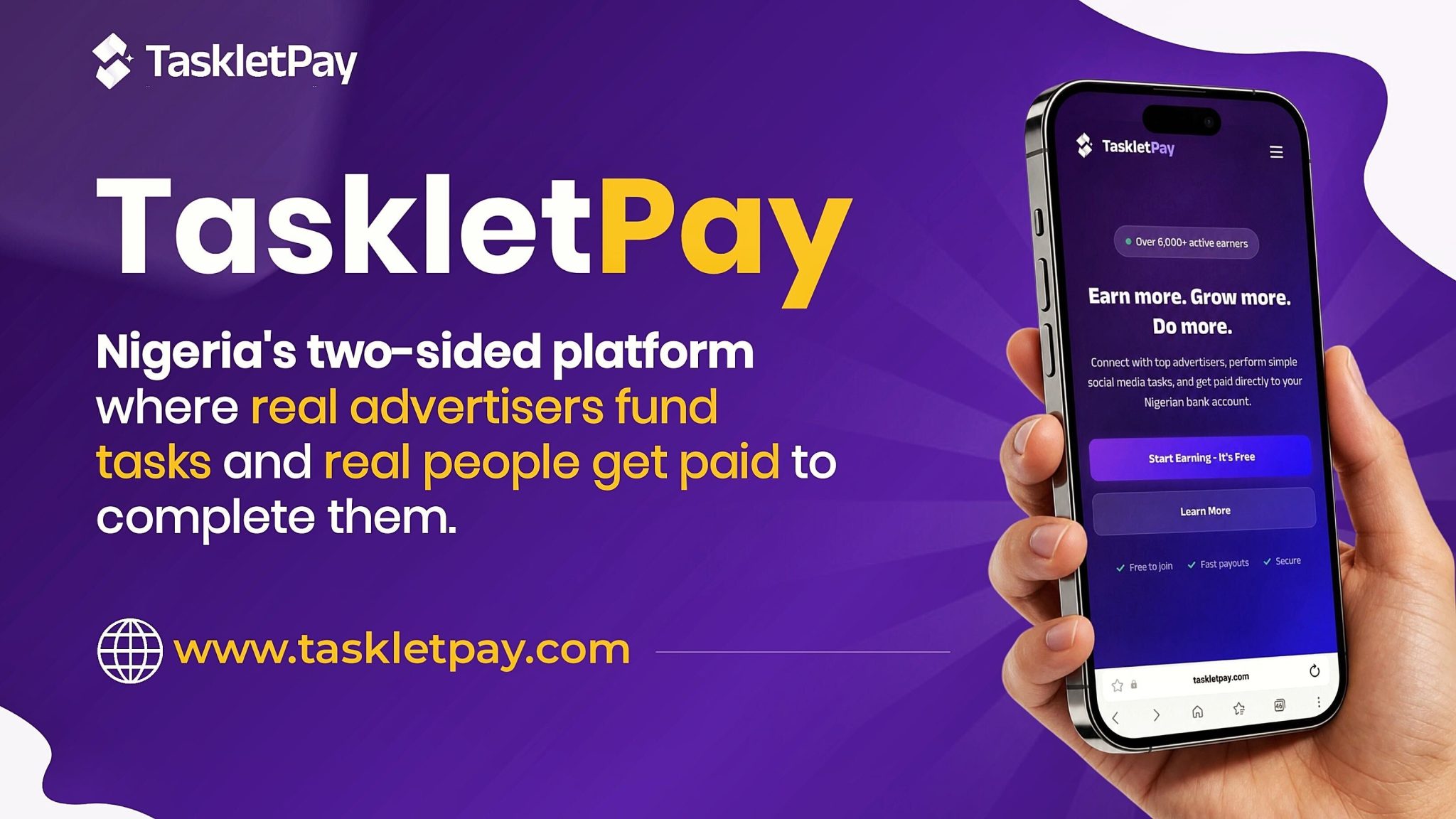
Nigeria’s digital economy is creating a new category of income platforms built around small, specific online tasks, offering an alternative to traditional freelancing and conventional gig work.
One example is TaskletPay, a Nigerian platform that connects advertisers looking for specific digital actions with people who complete those tasks for payment.
The model is relatively simple. Advertisers fund campaigns on the platform, while earners select available tasks, complete them and submit proof of completion before payment is released.
It creates a two sided marketplace where demand from advertisers and supply from digital workers can grow alongside each other.
A Different Kind of Digital Work
Task based earning sits somewhere between freelancing and gig work.
Traditional freelance platforms generally connect skilled professionals with project based work, while gig platforms often focus on physical services such as transportation, deliveries and errands.
Task marketplaces operate differently, focusing on smaller digital activities that can be completed without necessarily requiring specialised professional skills.
That makes the model potentially accessible to people who may not have the experience or portfolio required to compete for conventional freelance projects.
For advertisers, the proposition is also different. Instead of hiring an individual to complete a larger project, they can distribute smaller tasks across a pool of users and verify the results.
Verification Is Central to the Model
One of the key challenges for task based platforms is establishing that a task has actually been completed.
TaskletPay uses screenshot based verification, requiring earners to submit evidence of completed actions before payment is released.
The verification process is also designed to identify duplicate or invalid submissions before they are paid.
This creates an important layer between the advertiser and earner sides of the marketplace. Without reliable verification, advertisers could struggle to establish whether they received what they paid for, while earners could face uncertainty around whether completed tasks would be recognised.
For a platform operating at scale, payment reliability, fraud prevention and capacity management can become as important as attracting users.
Moving Beyond a Standalone Platform
TaskletPay is also positioning its infrastructure as something other platforms can connect to.
The company provides an API that allows social media marketing panel operators to use its task fulfilment infrastructure rather than developing their own systems from scratch.
Its Engagement Pack feature allows operators to combine multiple services into a single order. According to the platform, these orders can then be broken into separate underlying campaigns and distributed through its task network.
This turns TaskletPay from simply an earning platform into part of the infrastructure supporting other digital engagement businesses.
The approach also illustrates how task based marketplaces can operate behind the scenes, with users interacting with one platform while the actual task fulfilment is handled through another layer of infrastructure.
The Connection to Chickletboost
TaskletPay was developed by the same team behind Chicklet Official, which operates Chickletboost, a social media growth platform serving markets including Nigeria, Ghana and Kenya.
The two businesses remain separate platforms, but TaskletPay’s task workforce also fulfils part of Chickletboost’s Nigeria focused engagement orders.
That provides an existing example of the infrastructure being used across different customer facing products.
Rather than limiting the task marketplace to its own advertisers, the model allows external platforms to access the same fulfilment network through its API.
A New Layer in Nigeria’s Digital Economy
The emergence of task based earning platforms reflects how digital work in Nigeria is becoming increasingly fragmented.
Not everyone working online is a freelancer with a specialised service to sell. There is also a growing category of people looking for smaller, flexible digital income opportunities that can fit around other commitments.
Task marketplaces are targeting that gap by breaking digital work into smaller units that can be completed and paid for within shorter cycles.
The model still faces questions around sustainability, worker earnings, platform trust and the quality of tasks available. Whether task based earning becomes a significant part of Nigeria’s wider digital labour market will depend partly on how these platforms address those issues as they grow.
But the infrastructure is already taking shape.
Platforms such as TaskletPay show how digital work can be organised around individual tasks, verified completion and distributed participation, creating a model that sits between traditional employment, freelancing and informal online earning.
The bigger story may therefore not be any single task platform, but the emergence of an infrastructure layer for a new form of digital work in Nigeria.
Techmoni Africa tracks the Fintech, Web3, and Forex stories defining Nigeria, Kenya, and Ghana. Have a story that deserves attention? Reach our editorial team at info@techmoniafrica.com