

Africa’s fintech sector spent years building systems to stop fake identities from opening accounts. But a new threat is emerging, one where the criminals don’t need fake people at all.
Instead, they are using real faces, real identities, and real accounts.
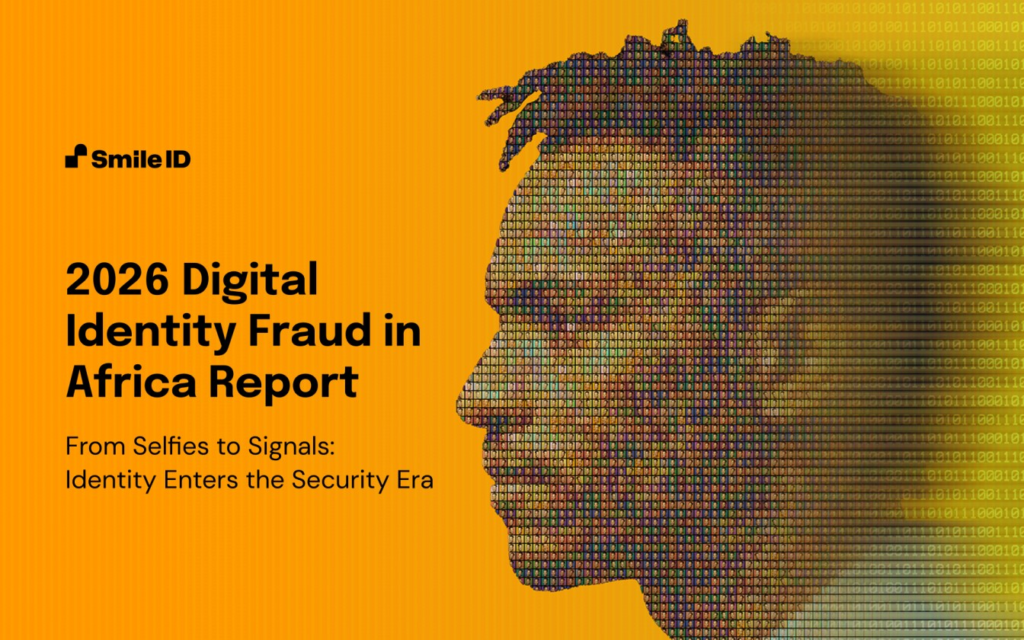
In a single month in 2025, one fraud syndicate used 100 stolen facial identities to launch more than 160,000 verification attacks across African fintech platforms, according to the “2026 Digital Identity Fraud in Africa Report” by Smile ID, a Lagos-based identity verification company.
The report analysed over 200 million identity checks across 35 African countries and 37 industries in 2025, part of a dataset exceeding 400 million verifications processed since 2019.
Its conclusion points to a fundamental shift in Africa’s digital security landscape: the biggest fraud risk is no longer fake users signing up, but verified accounts being hijacked months later.

Fraud is Moving Inside Fintech Platforms
For years, identity verification across African fintech platforms functioned like a checkpoint.
A new user submits an ID document and a selfie.
If the images match, the user gets access.
But attackers have moved beyond that stage.
The report found that fraud attempts targeting authentication flows—logins, password resets, device changes, and withdrawals—are now five times more common than attacks during account registration.
This shift exposes a major structural gap: most fintech security systems were built to verify identity once at onboarding, not continuously after the account becomes active.
“The most consequential fraud attacks today are targeted account takeovers (ATOs)—not fake IDs or isolated spoofs, but coordinated operations that compromise the capture pipeline, reuse real identities at scale, and exploit moments after approval when controls are lighter through highly scalable AI-powered tooling,” Smile ID noted in the report.
Why the Stakes Are Higher Than Ever
The shift comes at a critical time for Africa’s digital finance ecosystem.
Over the last decade, financial inclusion efforts dramatically expanded digital banking across the continent.
According to Smile ID:
- The percentage of African adults with financial accounts rose from 34% to nearly 60%
- More than 200 million new accounts were created during that period
But most of those accounts were secured only at the moment they were opened.
Once attackers gain access to an existing verified account, they can move money through fintech apps, digital wallets, and crypto platforms before fraud teams detect suspicious activity.
“When account takeovers become frequent enough that banks have to curtail services, trust erodes fast,” said Mark Straub, CEO of Smile ID.
“And in markets where digital financial services are still relatively new, that trust is fragile. If people decide it’s safer to go back to cash or informal systems, you reverse years of inclusion progress.”
The Rise of Africa’s Identity Supply Chains
One of the most striking discoveries in the report is how industrialised identity fraud has become.
Fraud networks now operate supply chains of stolen identities, combining biometric data, government ID details, and account credentials.
Key findings include:
- Some stolen identities appeared more than 12,000 times in verification attempts
- Another identity was used for over 1,000 account registrations within 30 minutes
- Fraud detection systems flagged 126,000 duplicate fraud attempts in 2025
That figure represents a sharp rise from:
- 52,000 attempts in 2024
- 21,000 attempts in 2023
These attacks often involve “identity farming,” where fraudsters create or hijack legitimate accounts and leave them inactive for months.
Once the accounts build transaction history and credibility, they are activated to move illicit funds.
AI Is Making Fraud Cheap and Scalable
Another major factor behind the surge is generative AI, which has dramatically lowered the cost of creating realistic fake identities and manipulating biometric verification systems.
According to the report:
- 69% of confirmed biometric fraud cases in 2025 involved AI-generated manipulation
- 20% were linked to known fraud networks
- 11% involved replay attacks or screen-based tricks
The AI-driven fraud methods include:
- Deepfake videos
- Synthetic faces
- Face swaps inserted into legitimate ID documents
- AI-generated selfies used to bypass verification
“In Southern Africa alone, we saw deepfake attempts surge 15× in one year, from under 200 monthly to over 3,000 by the end of 2025,” Straub said.
“Gen AI has reached a point where it can produce faces that look and appear real. Only with dynamic liveness challenges and additional metadata checks does the fraud reveal itself.”
Hackers Are Now Attacking the Verification Infrastructure
Fraudsters are also targeting the technology infrastructure behind identity verification, not just the identities themselves.
Smile ID detected over 100,000 injection-style attacks every month in 2025, where attackers used:
- Software-simulated smartphones
- Fake camera feeds
- Pre-recorded or AI-generated selfies
These attacks attempt to manipulate the capture process before the biometric data even reaches the verification system.
Nearly 90% of suspicious verifications were stopped through Smile ID’s mobile SDKs in 2025, compared with just 15% in 2023, showing how attackers increasingly exploit weaker API-based verification systems.
West Africa Is Seeing the Fastest Surge
The report notes that West Africa’s digital banking sector is experiencing some of the fastest growth in account takeover fraud.
Potential fraud attempts in retail banking rose roughly 50% in 2025, driven largely by attacks during login and account recovery.
The most common techniques include:
- Spoofing (33%)
- No-face-match failures (32%)
- Large-scale harvesting of National Identification Numbers (NIN) and Bank Verification Numbers (BVN)
Once attackers obtain these credentials, they pass them to money mules or insiders, who help move funds across multiple financial platforms.
Fraud Patterns Vary Across Africa
While West Africa leads in account takeover incidents, other regions show different risk patterns.
- Central and East Africa: Highest fraud rejection rate at 24%
- East Africa: Crypto, payments, and investment platforms face the most attacks
- Southern Africa: Deepfake impersonation dominates, with attacks increasing 15× in one year
- Francophone Africa: Document fraud remains the main threat due to stricter biometric regulations
These variations highlight how fraud networks adapt their tactics depending on regional regulation and platform vulnerabilities.
Identity Verification Is Becoming Security Infrastructure
The report concludes that African fintech companies must rethink identity verification entirely.
Instead of a one-time onboarding check, identity verification needs to function as a continuous security layer across the entire customer lifecycle.
“What we’re telling banks is that they need to invest in biometric Multi-factor Authentication to protect accounts from takeover, especially at high-risk moments like login, password resets, device changes, and high-value withdrawals,” Straub said.
“These need to be designed not just for convenience, but for continuous security.”
To defend against the new wave of fraud, the report recommends:
- Lifecycle intelligence that detects identity reuse
- Stronger authentication during high-risk actions
- Trusted capture systems that verify how identity evidence was generated
The Real Risk Ahead
As Africa’s digital economy continues expanding, the systems protecting hundreds of millions of financial accounts must evolve just as quickly as the criminals attacking them.
The biggest threat is no longer a fake identity trying to sneak into the system.
It is a real identity that someone else controls.
“The next few years will determine whether platforms adapt fast enough or whether rising fraud costs become the constraint that slows everything down,” Straub said.