

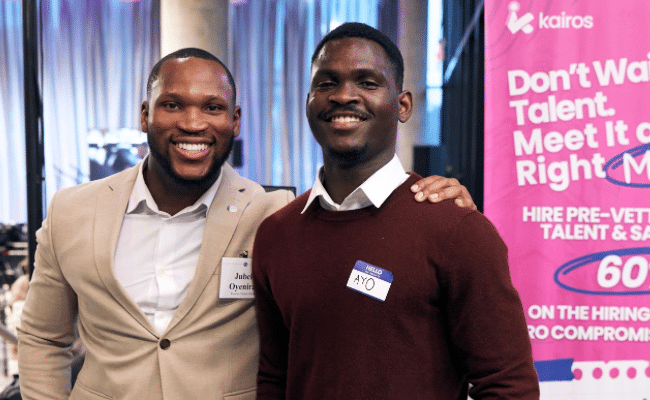
At 22 and 24, two young Nigerians are building what they believe could become one of the most structured bridges between African talent and U.S. small businesses — and they’ve just secured ₦75 million to prove it.
Ijebu-Ode–born Jubelo Oyeniran and former AXA professional Ayorinde Alase are the co-founders of Kairos Nexus Global, a cross-border outsourcing platform designed to help Nigerians earn in dollars by connecting them to verified remote opportunities in the United States.
The company recently secured ₦75 million (approximately $50,000) in non-dilutive funding through the Pava Innovation Award and won the Spark Impact Award — early signals of institutional confidence in its trust-first outsourcing model.
But the bigger story isn’t the money.
It’s the architecture.
Not Another Freelance Marketplace
Global hiring platforms like Upwork and Fiverr have made remote work accessible.
But accessibility hasn’t solved core problems:
- Identity ambiguity
- Inflated portfolios
- Contract disputes
- Payment exposure
- Inconsistent delivery
Kairos’ thesis is that the next evolution of outsourcing will not be about access — it will be about verification.
Instead of open bidding marketplaces, the platform integrates:
- Identity checks
- Skill validation
- Structured onboarding
- Escrow-backed engagements
- Compliance integration
Trust isn’t a feature. It’s infrastructure.
Business Architecture Meets AI Engineering
Kairos operates at the intersection of finance and technology.
Oyeniran, with an accounting background and currently completing a Master’s in Forensic Accounting (expected May 2026), leads:
- Strategy
- Growth
- Fundraising
- Financial structuring
- Revenue architecture
His focus: unit economics, cost arbitrage sustainability, and risk mitigation.
Alase, a former AXA employee and current PhD candidate in Computer Engineering, leads:
- AI-powered vetting systems
- Verification architecture
- Platform engineering
- Trust-layer automation
One builds the economic engine.
The other engineers the trust layer.
The Dollar Opportunity
For U.S. startups, payroll is often the largest cost line.
A mid-level developer in the U.S. can exceed $100,000 annually. Structured cross-border hiring can reduce comparable costs by up to 60%.
Kairos frames this not as job displacement, but as growth enablement.
Small businesses account for nearly half of private-sector employment in the U.S., yet:
- ~20% fail within their first year
- Nearly half fail within five years
- Capital constraints are a primary cause
Lower operating costs allow founders to:
- Extend runway
- Launch faster
- Reach product-market fit
- Reinvest into domestic hiring
In this model, outsourcing becomes a bridge to scale — not a substitute for local employment.


Why Nigeria First
Kairos begins in Nigeria for structural reasons:
- One of the largest youth populations globally
- Expanding pool of English-speaking digital professionals
- Competitive labor economics
- Strong diaspora linkages
But the platform is architected for multi-market expansion across emerging economies.
The goal is not volume.
The goal is structured credibility at scale.
Maryland as a Strategic Base
Operating from Maryland while sourcing talent in Nigeria positions Kairos as a capital amplifier for early-stage founders navigating funding gaps.
Access to pre-vetted global talent could mean the difference between:
- Shutdown and scale-up
- Delayed MVP and rapid deployment
- Capital burn and capital efficiency
For U.S. founders facing rising domestic costs, this model reframes outsourcing as disciplined growth infrastructure.
₦75 Million as Leverage, Not Lifeline
The ₦75 million secured through the Pava Innovation Award is non-dilutive — allowing the founders to retain ownership while accelerating execution.
Capital deployment includes:
- AI-assisted vetting systems
- Escrow and compliance integration
- Platform engineering
- Business onboarding infrastructure
Winning the Spark Impact Award adds ecosystem validation.
The company projects $500,000 in annual revenue within three years — a target tied directly to disciplined execution and structured scaling.
The Bigger Play
Remote work has eliminated borders.
But borderless hiring without structure creates risk.
Kairos is betting that the real competitive advantage in global outsourcing won’t be cheapest labor.
It will be engineered trust — supported by strong financial fundamentals.
If successful, Kairos Nexus Global won’t just help Nigerians earn in dollars.
It could redefine how credibility travels across continents.