
Discover how Lagos software engineers skillfully adapt to the AI-driven coding landscape in product development. AI-assisted software engineering is no longer experimental — it is already shaping how products are built. The real tension now isn’t speed. It’s structure. As more developers plug coding agents into their daily workflows, a new question is emerging across engineering teams in Lagos: how do you use AI to ship faster without compromising reliability, maintainability, and code clarity?
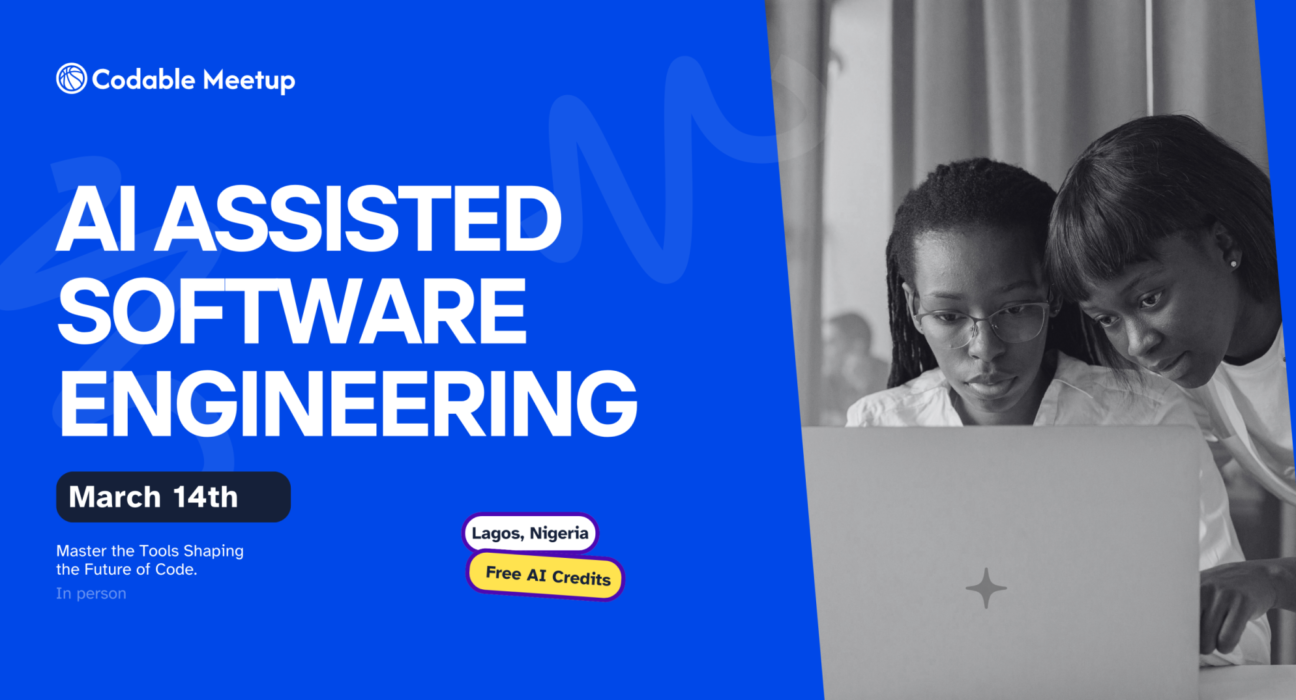
That conversation is moving offline on March 14 at 10:00 AM, as Codable Meetup hosts an in-person session at The Zone, Gbagada, focused not on hype — but on discipline.
From “Vibe Coding” to Verified Software
Across startups and product teams, AI coding tools are being used to:
- Scaffold features
- Refactor legacy codebases
- Write and expand test coverage
- Generate documentation
- Support implementation planning
The productivity upside is obvious. Faster drafts. Reduced debugging cycles. Fewer blank-page moments.
But speed without structure creates a new kind of technical debt:
- Unclear prompts
- Incomplete project context
- Weak specifications
- Inconsistent review processes
- No shared team standards for AI usage
The result? Teams ship faster — and sometimes ship confusion faster.
The Bigger Shift: The Engineer’s Role Is Changing
The meetup arrives at a time when software engineering itself is evolving.
Code is no longer the primary bottleneck.
Instead, the constraints are becoming:
- Problem framing
- Specification clarity
- Execution discipline
- Context management
AI-assisted workflows are pushing engineers toward orchestration roles — coordinating tools, agents, and reviews — rather than typing every line manually.
Some industry voices argue that practical forms of AGI are already influencing engineering productivity. Whether or not that claim holds philosophically, one thing is clear: AI agents are now embedded in real product workflows.
The question is how to harness them responsibly.
What This Meetup Is Actually About
This is not a motivational AI talk. It is structured around practical implementation.
1) Agentic Coding in Practice
The session will break down what “agentic coding” means beyond buzzwords.
Attendees will explore:
- How coding agents handle multi-step tasks
- Where agents fit best in a development lifecycle
- Where human oversight is non-negotiable
The focus is on repeatable workflows — not one-off prompts.
2) Context Engineering
One of the biggest reasons AI outputs fail is missing context.
The meetup will examine:
- How to provide structured codebase context
- How standards like Model Context Protocol (MCP) improve tool access
- What information models actually require
- How to reduce back-and-forth iterations
For engineers frustrated by technically correct but project-wrong outputs, this is a critical layer.
3) Spec-Driven Development (With AI in the Loop)
Speed without clarity increases rework.
This segment explores:
- Writing stronger implementation specs
- Using constraints to guide AI output
- Maintaining engineering discipline while accelerating delivery
- Improving reviewability and maintainability
The emphasis is on production-grade systems — not prototypes.
4) Multi-Agent Orchestration
As teams evolve beyond single prompts, coordination becomes complex.
Discussion topics include:
- When to deploy multiple agents
- Splitting work across research, coding, testing, and review agents
- Designing clean context handoffs
- Keeping human approval in control
- Using headless or proactive agents in background workflows
The objective: agents that function as structured teammates, not tools requiring constant babysitting.
Live Demos and Hands-On Participation
Unlike many AI discussions, this meetup includes live demos.
Attendees will also receive free AI credits to actively test workflows during sessions — turning theory into hands-on experimentation.
Practitioner-Led Conversations
The sessions are led by engineers already deploying AI-assisted workflows in real products.
Featured speakers include:
- Tobi Omotayo – Building Local Agents for Automating Knowledge Work
- Kerry Ehiokioya – Senior Frontend Engineer at Helium Health
- Taslim Oseni – Senior Android Engineer at Cowrywise
- Omoyeni Babatunde – Senior iOS Engineer at Fairmoney
- Precious Oaseru – Tech Lead
- Aderinola Odusanya – Senior Frontend Engineer
- Daniel Oniya – Senior Backend Engineer
A panel discussion will also examine the future of knowledge work in what some describe as the “intelligence age.”
Why In-Person Matters
The organizers argue that the most valuable insights won’t just come from presentations.
They will likely emerge from peer conversations around:
- Code review policies for AI-generated pull requests
- Prompt strategies for specific stacks
- Guardrails against hallucinated changes
- Team-wide standards for production usage
For many Lagos-based engineers, those Monday-morning answers are the real value.
Event Details
- Date: March 14
- Time: 10:00 AM
- Venue: The Zone, Gbagada, Lagos
- General Admission: ₦20,000
- Women in Tech: ₦10,000
Registration is via Luma. https://luma.com/r6zo41fu
Why This Story Matters for Lagos
Lagos is rapidly becoming one of Africa’s most active engineering ecosystems. As AI-assisted development tools mature, local teams face the same structural questions as global counterparts — but often without access to deeply contextual, practitioner-led discussions.
Meetups like this suggest a shift: from experimenting with AI tools individually to institutionalizing AI workflows collectively.
And in a market where execution speed increasingly defines competitive advantage, that shift could shape how the next generation of African software products is built.